Optimising Farm Value Chain Efficiencies
Certification Guide and FAQs
Understanding our certification steps and key document definitions
Granjero de Bauer Certification Journey
At Granjero de Bauer, we believe that every producer, regardless of size, deserves access to high-quality standards, trusted markets, and sustainable growth. Our certification pathway is designed to be practical, supportive, and achievable, guiding you step-by-step from where you are today to recognized excellence.
1. Capacity Development
We provide hands-on training and simple, practical guidance tailored to your farm size and reality helping you understand what is required and how to implement it effectively.
2. Guided Self-Assessment
Using easy-to-follow tools, you assess your current practices, identify gaps, and receive clear direction on what to improve at your own pace.
3. Simple Registration
We make onboarding straightforward and transparent, ensuring you can begin your certification journey without unnecessary complexity.
4. Supportive Assessment
Our trained assessors work with you to evaluate your farm focusing not just on compliance, but on helping you meet the required standards with confidence.
5. Certification & Opportunity
Once certified, you gain recognition that builds trust, improves your farm’s value, and opens doors to better markets and partnerships.
Why Certification Matters
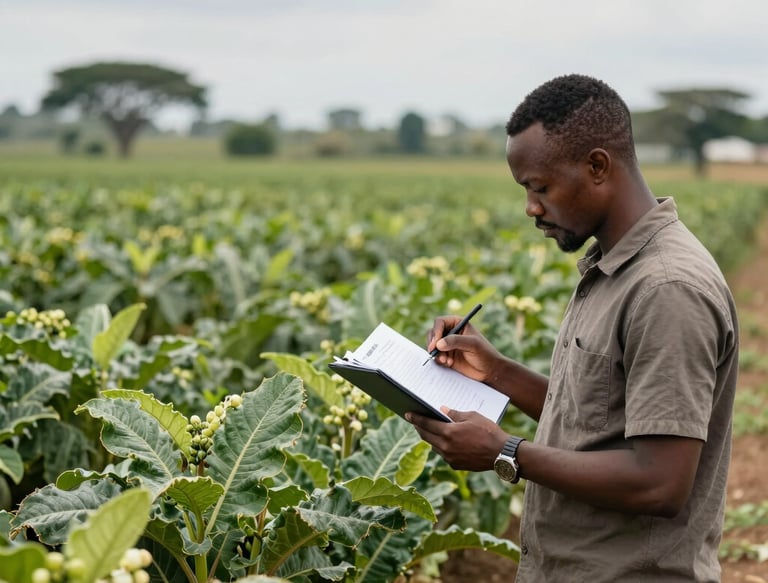
Certification matters in Nigeria and Africa to build trust, develop record-backed data pivotal to continous improvements, boosts quality, and opens doors to new trust inclined markets within and across Africa
GENERAL FAQ: Agricultural Certification & Standards
Quick overview
Q — What is an agricultural “standard”?
A — A standard is a clear set of practical rules and steps that describe how to grow, harvest, store and handle crops and animals so the food is safe, the animals are treated well, the workers are protected, and the land and water are cared for. Standards tell farmers what to do and how to prove they did it.
Q — What is “certification”?
A — Certification is a formal check by an independent, trained person or organization that the farm follows the standard. If the farm passes the check, it receives a certificate or label that buyers trust. Certification is proof that the farm meets the standard.
Why certification matters (for farmers, buyers and communities)
Q — Why would a small farmer want certification?
A — It brings practical benefits:
Better prices — certified products often earn higher prices or preferred contracts.
Records - Producers are able to keep and monitor records while also tracking progress
More buyers — processors, supermarkets and exporters often ask for certification as it creates more stability and sustinability.
Safer food — fewer pests, diseases and chemical residues; better public health.
Stronger planning — simple record-keeping helps you spot problems and plan costs.
Training & support — many certification programs include farmer training and templates.
Access to finance and Insurance — Producers become more credit worthy with a documented proof of competence, lenders and development programs prefer certified or compliant farms along side insurance companies
Group opportunities — smallholders can join group certification to share costs and benefits.
Q — Why does a buyer ask for certification?
A — Buyers want consistent quality, and in many cases quantity, legal compliance, and reduced risk (food safety, reputational, and legal structures). A certificate means less time checking each farm and more confidence for their customers.
Q — Does certification protect the environment and workers?
A — Yes: modern standards include rules on soil care, water management, pesticide use, waste handling, and worker safety (fair pay, training, protective equipment).
The certification process — step by step
Q — What is a typical certification process?
A — A typical pathway
Get the standard & checklist. Read the Basic requirements or ask a trainer.
Self-assessment. Use the checklist to find gaps.
Fix gaps. Build quarantine, start treatment logs, change farm layout — small steps matter.
Training. Train staff in handling, PPPs, records, and biosecurity to mention a few
Pre-audit (optional). A mock audit to practice.
Formal audit. Independent auditor visits, checks records and the farm.
Decision & certificate. Pass, conditional pass (fixes needed), or fail (critical issue).
Maintain & re-audit. Certificates last a year or two; re-audit required.
Q — What documents & records will auditors look for?
A — Typical list:
Farm identification & map
Animal/crop IDs or batch records
Treatment & withdrawal log (medicine name, dose, date, withdrawal end)
Quarantine log for incoming animals or new plants
Pest management & spray records (for crops)
Harvest & post-harvest records (dates, storage conditions)
Visitor log & vehicle records
SOPs for key tasks (quarantine, treatment, washing, storage)
Training records for staff
Audits, non-conformities & appeals
Q — Who does the audits?
A — Independent auditors trained to the standard. They must be impartial and follow an audit protocol.
Q — What happens if I fail?
A — Outcomes:
Pass — certificate issued.
Conditional pass — minor or moderate non-conformities: you get time to fix them and a follow-up.
Fail (Critical non-conformity) — immediate suspension until critical issues are corrected.
Auditors give a report; you can appeal via the scheme’s appeals process.
Q — How long is a corrective action period?
A — Often 30–90 days for moderate issues; some critical issues require immediate correction (e.g., evidence of prohibited drug use).
Costs, finance & group certification
Q — How much does certification cost?
A — Costs vary: audit fees, training, changes to facilities and record systems. Smallholders can be certified more cheaply via group certification (cooperatives) and donor subsidies. You can see our catalogue for our prices.
Q — What is group certification?
A — A group of small producers (cooperative) applies together under one certificate. The group manager ensures members meet standards. Group certification reduces per-farm audit cost and helps smallholders participate
Crop & post-harvest specifics (not only animals)
Q — What is GAP for crops?
A — Good Agricultural Practices (GAP) are simple rules and guiding principles on: Sustainability structures and strategies, safe input use, irrigation management, worker hygiene, harvest timing and post-harvest handling (drying, sorting, storage) to reduce contamination and all other practices that give producers confidence and assurance in their production and products derived.
Q — What about pesticides and residues?
A — Pesticides must be used according to label instructions. Record each spray (product, dose, date). Observe withdrawal periods (pre-harvest intervals). Buyers/test labs check residues against MRLs (Maximum Residue Limits). Test your produce if in doubt.
Q — How do we manage aflatoxin and mycotoxins?
A — Avoid harvest of moldy crops, dry quickly to safe moisture levels, use clean storage, test high-risk commodities (groundnut, maize). If high aflatoxin detected, do not sell for human consumption.
Q — What about post-harvest handling and storage?
A — Clean drying surfaces, raised platforms, good airflow in granaries, pest control, regular inspection. Proper packaging and traceability of batches helps during recalls.
Environmental, social & worker concerns
Q — Are workers protected by standards?
A — Yes. Many standards require child protection (no child labour), fair pay, PPE for chemical handling, and training. Audits typically assess worker conditions.
Q — How do standards protect water & soil?
A — Require nutrient management (manure spreading rules), buffer zones to water sources, erosion control and safe chemical storage/disposal.
Traceability, recalls and food safety
Q — What is traceability?
A — The ability to trace a product back to the farm (one-step back) and forward to buyer (one-step forward). It uses BatchIDs, transfer forms and dispatch notes so you can quickly find the source of a problem.
Q — What is a mock recall?
A — A test: pick a dispatched batch and try to trace it back and forward quickly. This shows how fast you can find and remove unsafe products. Good standards require regular mock recalls.
Market access & value chain
Q — How does certification help me sell more or export?
A — Certification removes doubt for buyers: buyers prefer sources that they are confident in their production process with a lower risk of hazards. For export, many buyers require certification or evidence of compliance with international standards.
Q — What markets pay best?
A — Premium domestic processors, supermarket chains, processors for export, and niche markets (organic, fair trade, GLOBALG.A.P) pay higher prices. The exact market depends on the product and quality.
Safety, residues & laboratory testing
Q — When should I test for residues or mycotoxins?
A — Test when: you use new pesticides/medications, you suspect contamination (wet storage, mold), before bulk sales for export, or as required by buyers.
Q — Which lab and standards?
A — Use an accredited laboratory (ISO/IEC 17025). For export, check importing country MRLs and Codex.
Practical checklist to start
Get the standard & basic checklist (Basic tier).
Set up a small Farm File (SOPs, treatment log, movement log, visitor log).
Build a 14-day quarantine area for new stock.
Start a treatment & withdrawal log (medicine, date, dose, end of withdrawal).
Mark treated animals/produce during withdrawal.
Clean & dry storage for crops; test risky crops for aflatoxin.
Train one person as standards manager.
Run a mock audit (self-check or with an adviser).
Book a formal audit when ready.
GRANJERO DE BAUER
Q — What is Granjero de Bauer’s role in agricultural certification?
A — GB develops practical, locally adapted standards for crops and animals, focusing on farm-level implementation for Nigerian & African conditions. GB provides training, SOPs, mock audits, independent audits (Basic/Advanced/Premium), group certification pathways, traceability templates and market linkage services.
Q — How is GB different from other certification bodies?
A — Key differences:
Local adaptation — GB simplifies international best practice into steps that match local climate, disease and farm scale.
Farm-first design — Basic tier for smallholders; cooperative/group certification model.
Practical tools — Ready SOPs, printed pocket cards in Hausa/Igbo/Yoruba, and farmer handouts.
Support — Mock audits, subsidised prep (where donors apply), and direct market introductions.
Q — What sectors does GB cover?
A — GB has standards for livestock (goats, sheep, cattle, turkeys), poultry (broilers, layers), and crop production (vegetables, cereals, legumes) — all focused on primary production and pre-harvest/post-harvest controls.
Q — What are the GB certification tiers?
A — Basic (domestic & smallholders), Advanced (larger farms & better traceability), Premium (export grade: full electronic traceability, routine residue testing, audited processors). Each tier has clear checklists.
Q — What support does GB provide before audit?
A — GB offers: training (local languages), SOP templates, record templates, mock audits, and advisory visits. GB can link farmers to vets and labs for testing.
Q — Who does the audit and how are they trained?
A — Independent auditors approved by GB — they undergo GB training, competency testing and monitoring. GB ensures auditor impartiality and quality assurance.
Q — How does GB use donor funds & fees?
A — Fees cover audit administration and quality systems. Donations support standards development, training for smallholders, subsidized audit prep and pilots. GB publishes annual impact and financial reports.
Q — How does GB measure impact?
A — KPIs: farms trained, audits completed, certified farms, reductions in residues or mortality, income changes, traceability performance. GB publishes summary reports.
Q — How to start with GB?
A — Contact GB (email or website), receive a starter checklist, join training, do a self-assessment, prepare records and request a mock audit or schedule an official audit.
Q — Data privacy & farmer ownership?
A — GB keeps farmer data secure; farmers own their data; GB publishes anonymized impact data only with consent.
Q — Complaints & appeals?
A — GB operates a transparent grievance & appeals process: written complaint → independent panel review → response/appeal with timelines.
Contact us
Expert farm standardization and agricultural practices consulting.
contact@granjeronigeria.org
+234-807035083460
© 2026. All rights reserved.